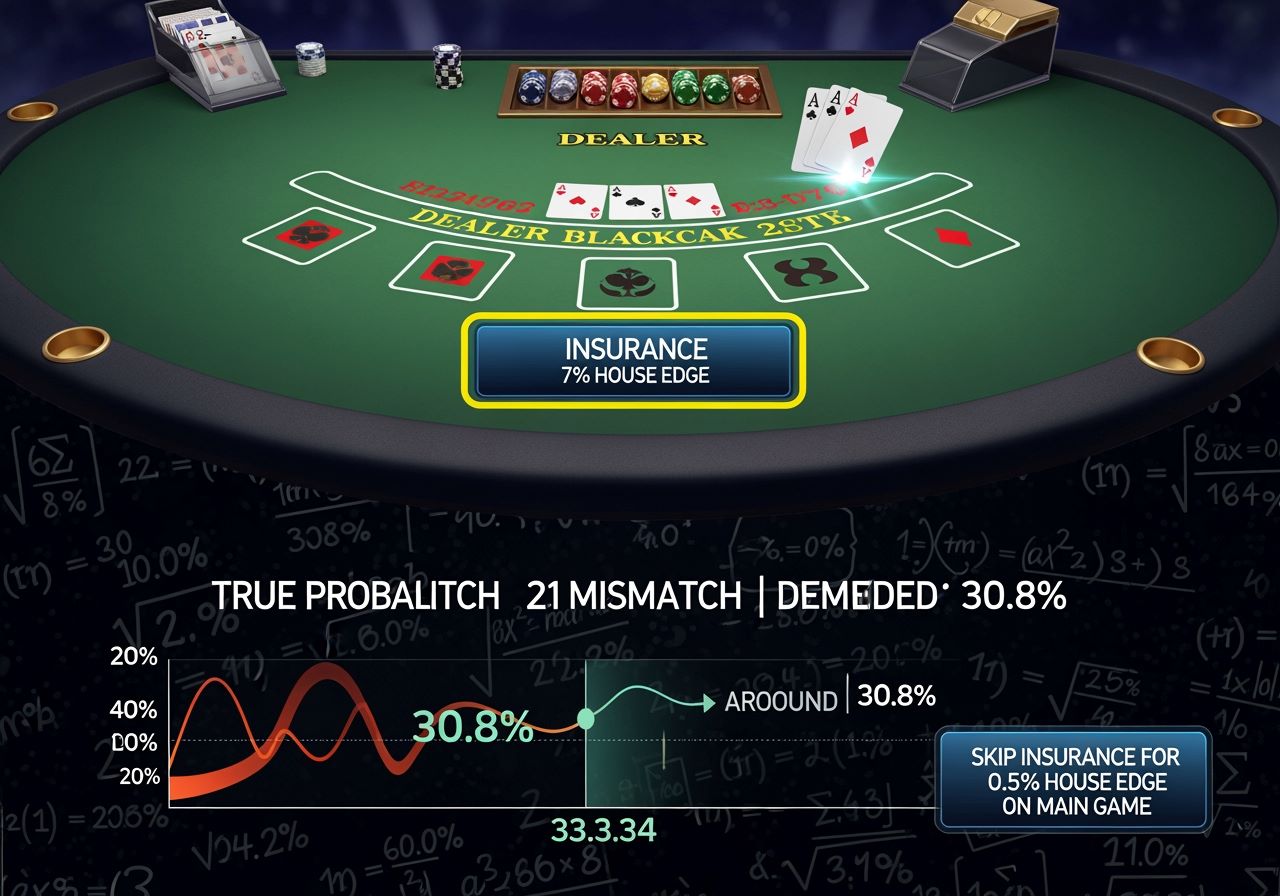
The insurance bet in blackjack is often marketed as “protection” against dealer blackjack, but this seemingly helpful wager actually adds approximately 7% to the house edge. While insurance pays 2:1 when the dealer shows an ace and completes blackjack, the gap between true odds and payout structure creates a significant mathematical disadvantage for players.
The core issue lies in the odds mismatch: in multi-deck games, the probability of dealer blackjack hovers around 30.8%, while the break-even threshold for 2:1 payouts requires 33.3%. This disparity becomes particularly pronounced in US casinos where 6-deck and 8-deck games dominate the floor, making insurance one of the worst bets available to casual players.
Smart blackjack players should skip insurance entirely and focus on the main game’s superior 0.5% house edge. Understanding the mathematical foundation behind this recommendation requires examining the exact calculations, probability distributions, and expected value formulas that expose insurance as a costly illusion of security.
What Is the Blackjack Insurance Bet?
Insurance represents a side bet offered when the dealer’s upcard shows an ace, allowing players to wager up to half their original bet on whether the dealer has blackjack. This optional wager pays 2:1 if the dealer’s hole card is a 10-value card, completing a natural blackjack hand.
Despite being positioned as a protective measure, insurance functions as an independent bet with its own house edge and payout structure. The common myth suggests insurance “hedges” your main bet against dealer blackjack, but mathematically, it operates as a separate wager that consistently favors the casino regardless of your primary hand’s strength.
When Is Insurance Offered?
The insurance opportunity follows specific timing and betting parameters that players must understand before the dealer checks for blackjack.
- Dealer’s ace upcard immediately triggers the insurance offer
- Maximum insurance bet equals exactly half of your original wager
- All insurance decisions must be made before dealer reveals hole card
- Insurance bets resolve independently of main hand outcomes
- Players can decline insurance and continue with original strategy
- Even money option available for player blackjack hands against dealer ace
Insurance Payout Structure
Insurance payouts follow a straightforward 2:1 ratio when the dealer achieves blackjack, meaning a $10 insurance bet returns $20 profit plus the original $10 wager. If you hold blackjack while taking insurance, the result becomes a push on your main bet combined with the insurance win.
When the dealer’s hole card isn’t a 10-value, insurance bets lose immediately regardless of subsequent hand developments. This loss occurs even if your main hand eventually wins, demonstrating why insurance operates as an independent side bet rather than true protection for your primary wager.
Core Probability Behind Insurance
The fundamental mathematics behind insurance reveals why this bet consistently favors the house across all common blackjack variations. In multi-deck games, approximately 30.8% of remaining cards hold 10-values after the dealer shows an ace, falling short of the 33.3% probability required for break-even results at 2:1 payouts.
This probability gap represents the casino’s mathematical advantage, creating a house edge that ranges from 5.9% in single-deck games to over 7% in standard 6-deck variations. The house gains because true odds consistently fall short of payout requirements, generating long-term profits regardless of short-term variance.
Single-Deck vs Multi-Deck Odds
The number of decks significantly impacts insurance probabilities, with single-deck games offering slightly better odds for players while multi-deck variations increase the house advantage.
| Decks | 10s Remaining Ratio | Dealer BJ Probability | House Edge Impact |
|---|---|---|---|
| Single Deck | 16/51 (31.4%) | 31.4% | 5.9% |
| Double Deck | 32/103 (31.1%) | 31.1% | 6.8% |
| Six Deck | 96/311 (30.9%) | 30.9% | 7.4% |
| Eight Deck | 128/415 (30.8%) | 30.8% | 7.7% |
Why 33.3% Break-Even?
The 33.3% break-even threshold emerges directly from the expected value formula for 2:1 payouts, where players need to win at least one-third of insurance bets to avoid long-term losses. Since insurance pays $2 for every $1 wagered, the probability of dealer blackjack must exceed 33.3% to generate positive expected value.
This mathematical requirement creates an insurmountable gap in standard blackjack games, where 10-value cards represent exactly 30.8% of remaining cards in 8-deck shoes. The 2.5 percentage point difference translates directly into the house edge, making insurance a consistently losing proposition for basic strategy players.
Exact House Edge Calculation Formula
The precise house edge calculation for insurance bets follows the standard expected value formula: EV = (Probability × 2) – (1 – Probability). This equation accounts for the 2:1 payout when winning and the complete loss of the wager when the dealer doesn’t have blackjack.
For 6-deck games, the calculation becomes: EV = (0.309 × 2) – (1 – 0.309) = 0.618 – 0.691 = -0.073. Converting this negative expected value to house edge terms: House Edge = (-EV) × 100% = 7.3%. This 7%+ disadvantage makes insurance one of the worst bets available in most US casinos.
Understanding this formula helps players recognize why insurance consistently drains bankrolls over extended play sessions. The mathematical certainty of long-term losses makes insurance particularly dangerous for recreational players who may not track their side bet performance separately from main game results.
Step-by-Step Math Example
A detailed 6-deck calculation demonstrates exactly how the house edge emerges from the probability-payout mismatch. This example uses realistic casino conditions found throughout Las Vegas and Atlantic City.
- Start with 312 total cards in 6-deck shoe, minus dealer’s ace upcard = 311 remaining cards
- Count 10-value cards remaining: 96 cards (24 tens, jacks, queens, kings per deck × 6 decks – 0 seen)
- Calculate dealer blackjack probability: 96/311 = 0.3087 or 30.87%
- Apply expected value formula: EV = (0.3087 × 2) – (0.6913 × 1) = 0.6174 – 0.6913
- Determine final expected value: EV = -0.0739 per dollar wagered
- Convert to house edge percentage: 7.39% house advantage
- Apply to $10 insurance bet: Expected loss of $0.74 per wager
House Edge by US Game Variations
Different blackjack variations across US casinos produce varying insurance house edges, with single-deck games offering the best odds and 8-deck shoes creating the highest casino advantage. Las Vegas Strip casinos typically feature 6-deck games with approximately 7.4% insurance house edge, while downtown Vegas and regional casinos often use 8-deck shoes that push the edge above 7.5%.
| Game Type | Decks | Insurance Edge | Notes |
|---|---|---|---|
| Vegas Strip | 6 | 7.4% | Most common variation |
| Downtown Vegas | 8 | 7.7% | Higher edge, lower limits |
| Atlantic City | 6-8 | 7.4-7.7% | Mixed deck counts |
| Single Deck | 1 | 5.9% | Best insurance odds |
| Double Deck | 2 | 6.8% | Rare in modern casinos |
| Continuous Shuffle | 6-8 | 7.7% | Eliminates counting advantage |
Impact of Rule Changes
Standard rule variations like dealer stands on soft 17 (S17) or double after split (DAS) have minimal impact on insurance house edge since these rules affect main game play rather than the side bet mathematics. The insurance calculation depends solely on the ratio of 10-value cards to total remaining cards, making it largely independent of other blackjack rule modifications.
However, games with altered deck composition or non-standard card removal procedures can affect insurance odds. Some novelty blackjack variants remove certain 10-value cards or use modified deck structures, potentially changing the fundamental probability calculations that determine insurance house edge.
Card Counting Exception
Professional card counters using Hi-Lo or similar systems can identify rare situations where insurance becomes mathematically profitable, typically when the true count reaches +3 or higher. At this threshold, the concentration of remaining 10-value cards exceeds the 33.3% break-even point, creating positive expected value for insurance bets.
This counting exception represents the only scenario where insurance offers player advantage, but it requires advanced skills, significant bankroll requirements, and tolerance for casino countermeasures. Recreational players should never attempt insurance betting based on informal card tracking or “gut feelings” about remaining deck composition.
Insurance vs Other Side Bets
Insurance consistently ranks among the worst side bet options available in US casinos, often exceeding the house edge of popular alternatives like 21+3, Perfect Pairs, or Lucky Ladies. While most blackjack side bets carry substantial house advantages, insurance’s 7%+ edge makes it particularly costly for regular players.
| Side Bet | House Edge | $25 Loss | When Offered |
|---|---|---|---|
| Insurance | 7.4% | $1.85 | Dealer ace upcard |
| Perfect Pairs | 5.8% | $1.45 | Before dealing |
| 21+3 | 3.2% | $0.80 | Before dealing |
| Lucky Ladies | 24.7% | $6.18 | Before dealing |
| Royal Match | 6.4% | $1.60 | Before dealing |
| Super Sevens | 11.2% | $2.80 | Before dealing |
| Over/Under 13 | 6.5% | $1.63 | Before dealing |
| Bust Bonus | 4.7% | $1.18 | During play |
Why All Side Bets Lose
The fundamental issue with blackjack side bets stems from their mathematical structure, which consistently favors the house through payout-to-probability mismatches.
- Main game blackjack offers 0.5% house edge with basic strategy
- Side bets typically carry 3-25% house advantages
- Frequent betting on side wagers dramatically increases total cost per hour
- Higher volatility creates larger bankroll requirements
- Most side bets resolve quickly, increasing hands per hour exposure
- Casino marketing emphasizes excitement over mathematical reality
Expected Value Examples
Real-world expected value examples demonstrate how insurance bets consistently drain player bankrolls across various betting levels and session lengths. A $10 insurance bet carries an expected loss of $0.74 per wager, meaning players lose nearly three-quarters of a dollar every time they take insurance on dealer aces.
| Bet Size | Sessions | Insurance Bets | Edge Loss | Main Game Loss |
|---|---|---|---|---|
| $5 | 10 | 8 | $2.96 | $2.50 |
| $10 | 20 | 15 | $11.10 | $5.00 |
| $25 | 50 | 38 | $70.30 | $12.50 |
| $50 | 100 | 76 | $280.60 | $25.00 |
| $100 | 200 | 152 | $1,122.40 | $50.00 |
Long-Term Simulation
Extended play simulations reveal how insurance losses compound over thousands of hands, often exceeding main game losses despite representing a smaller portion of total action. Players who consistently take insurance typically lose 10-15 times more money on the side bet compared to optimal basic strategy play on their primary hands.
The frequency of insurance opportunities amplifies these losses, as dealer aces appear approximately once every 13 hands in multi-deck games. Regular players face insurance decisions multiple times per hour, creating numerous opportunities for the house edge to extract value from poor betting choices.
Even Money Alternative
The “even money” option for player blackjack against dealer ace represents identical mathematics to insurance betting, carrying the same 7%+ house edge despite appearing more conservative. When players accept even money, they receive 1:1 payout immediately rather than risking a push against dealer blackjack.
Mathematically, even money equals taking insurance when holding blackjack, as both options guarantee the same payout while sacrificing the superior 3:2 blackjack return. Smart players decline even money and insurance equally, accepting occasional pushes in exchange for full 3:2 payouts when the dealer doesn’t have blackjack.
Basic Strategy: Always Decline Insurance
Proper blackjack basic strategy requires declining insurance in virtually all circumstances, as the mathematical disadvantage makes this side bet consistently unprofitable for non-counting players. Standard basic strategy charts universally recommend against insurance regardless of your hand strength or the specific game variation.
The decision becomes particularly important for serious players because insurance mistakes add significant cost over extended play sessions. Unlike hitting or standing errors that occur occasionally, insurance opportunities arise frequently enough to create substantial long-term financial impact when handled incorrectly.
- Decline insurance offers immediately without analyzing your hand composition
- Avoid “even money” when holding blackjack against dealer ace
- Focus bankroll management on main game strategy rather than side bet hedging
- Track insurance decisions separately to monitor their impact on overall results
- Study probability calculations to reinforce confidence in declining insurance
- Practice proper responses to dealer insurance offers before playing live
- Maintain discipline even during losing streaks when insurance seems appealing
Common Player Mistakes
Insurance betting consistently ranks as the most costly error recreational blackjack players make, often surpassing basic strategy mistakes in terms of financial impact.
| Mistake | Edge Increase | Fix |
|---|---|---|
| Taking Insurance | +7.4% | Always decline |
| Even Money on BJ | +7.4% | Accept pushes for 3:2 payouts |
| Hard 16 vs 10 | +0.5% | Hit instead of stand |
| 12 vs 2-3 | +0.3% | Hit instead of stand |
| Soft 18 vs 9 | +0.2% | Hit instead of stand |
US Casino Specifics & Tips
US casinos predominantly feature 6-deck and 8-deck blackjack games with insurance house edges ranging from 7.4% to 7.7%, making this side bet consistently unprofitable across all major gaming markets. Las Vegas Strip properties typically offer 6-deck games, while downtown Las Vegas and regional casinos often use 8-deck shoes that slightly increase the insurance disadvantage.
Players should prioritize finding games with favorable main bet rules rather than focusing on insurance variations, as 6:5 blackjack payouts create a far more significant disadvantage than insurance house edge differences. Seek tables offering 3:2 blackjack payouts, dealer stands on soft 17, and double after split options to minimize overall casino advantage.
Best US Blackjack Rulesets
Optimal blackjack conditions across US casinos combine multiple player-favorable rules while maintaining reasonable table limits and game availability.
- 3:2 blackjack payouts instead of 6:5 or even money variations
- Dealer stands on soft 17 reducing house edge by 0.2%
- Double after split allowed for increased strategic flexibility
- Surrender permitted on unfavorable hands against strong dealer upcards
- Re-splitting aces when available for improved pair hand outcomes
- Penetration exceeding 75% for better card counting opportunities